

As It Is
Most people skim through these words of the Buddha — yet it’s the meditation instruction he gave the most.

Hi friend,
Can you be aware of this moment as it is?
Not how you’d like it to be but as it is?
Without dividing it into mental objects but as it is?
As It Is
In the over eight thousand suttas, the Buddha talks about experiencing life “as it is” more than four thousand times.
This is more than any other meditation instruction he ever gave.
I am guilty of having brushed this instruction as too simple in the past.
I glanced over the words “as it is” as if these were just filler words.
The repetition made it boring.
For my concept-hungry mind, “as it is” didn’t seem to provide anything new.
Over time, I realized that this was the point — to stop conceptualizing.
To stop complexifying. To stop interpreting. To stop adding anything to our direct experience.
To rest in the open, free, naked, simple and alive space that exists prior to interpretations.
Aware of all sights, sounds, sensations, thoughts and consciousness as they are.
Letting everything be the way it is.
I guess that if the Buddha had only instructed students to “experience life as it is”, very few would have been liberated — because these words alone wouldn’t bring their minds enough confidence and direction to fully surrender to the present moment.
Therefore the Buddha kindly presented the path to liberation with many words, explanations, and techniques.
But really, meditation is all about experiencing life as it is.
Yathābhūtaṁ
Yathā = as, like, just as, in whatever way.
Bhūtaṁ = existing, being.
Yathābhūtaṁ = as it is.
Here are the most common ways in which yathābhūtaṁ appears in the suttas:
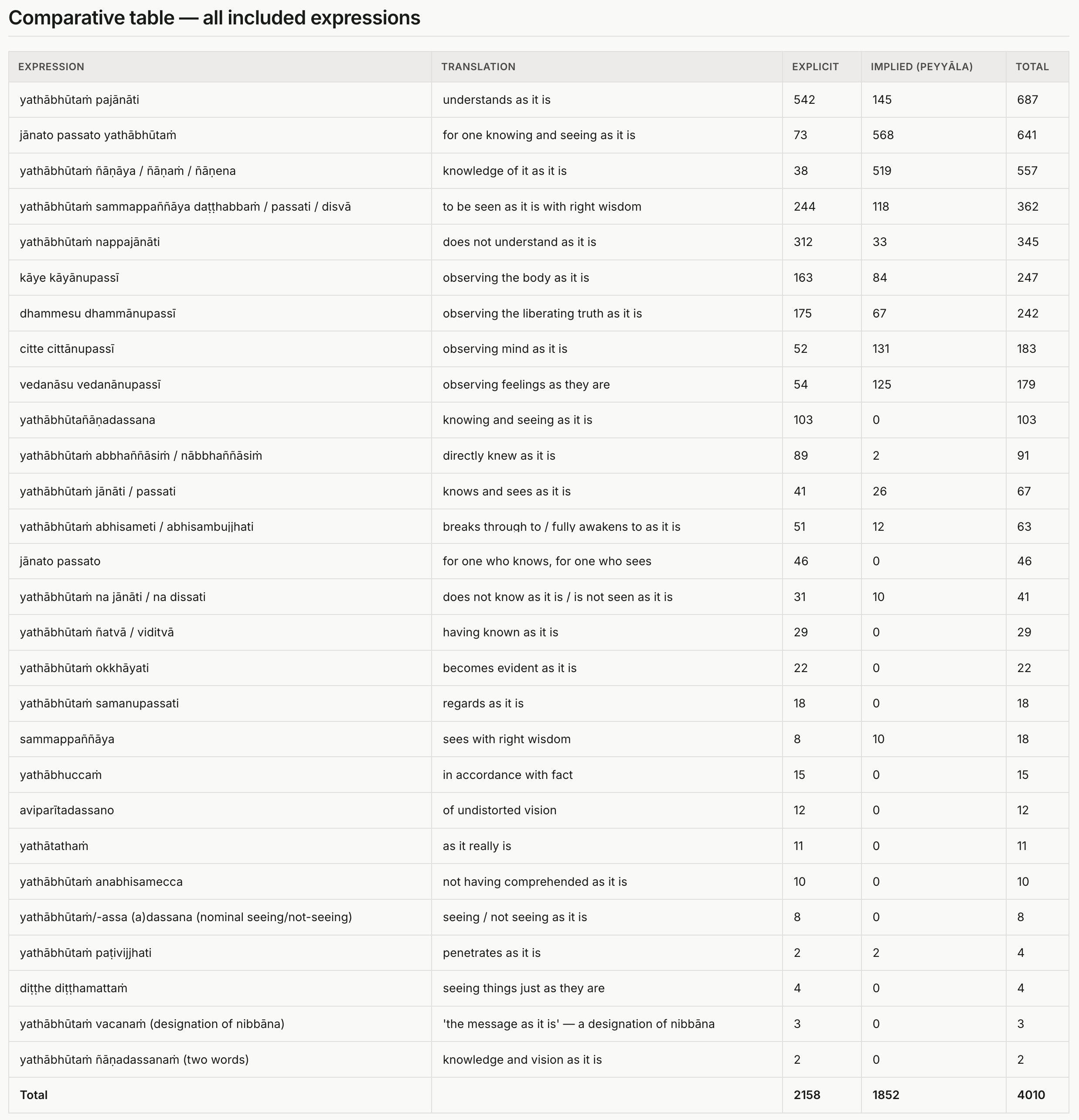
yathābhūtaṁ pajānāti = understands as it is (687 occurences) — usually in reference to the four sacred truths, dependent origination, …
jānato passato yathābhūtaṁ = for one knowing and seeing as it is (641 occurences)
yathābhūtaṁ ñāṇaṁ = knowledge of things as they are (557 occurences)
yathābhūtaṁ sammappaññāya daṭṭhabbaṁ = should be seen as it is, with correct understanding (362 occurences)
Kāye kāyānupassī, vedanāsu vedanānupassī, citte cittānupassī, dhammesu dhammānupassī
These are the stock expressions the Buddha used whenever he talked about mindfulness.
Kāye = in the body (locative)
Kāyānupassī = kāya = the body + anupassī = observing
This expression is often translated too literally as “observing the body in the body”, which doesn’t mean anything and isn’t a helpful meditation instruction.
The invitation of the Buddha, here, is to observe the body… well, you guessed it — as it is.
It’s like in Kantian philosophy, the expression “things in themselves”1 refers to “things as they are” — as opposed to how things appear to us through our conceptualization processes.
I translate “kāye kāyānupassī” as “observing the body as it is” because it’s logical, in accord with the suttas, and leads to meditative bliss.
Kāye kāyānupassī = observing the body as it is (247 occurences)
Vedanāsu vedanānupassī = observing sensations as they are (179 occurences)
Citte cittānupassī = observing the mind as it is (183 occurences)
Dhammesu dhammānupassī = observing healing truths as they are (242 occurences)
Establishing awareness in these four objects opens us to life and liberates the mind.
Diṭṭhe diṭṭhamattaṁ bhavissati
Many Buddhists remember the story of the ascetic Bāhiya who walked several days to learn from the Buddha.
When Bāhiya finally saw the Buddha, the Buddha was begging for alms, but this didn’t deter Bāhiya from approaching him.
At first, the Buddha gently reprimanded Bāhiya for asking questions at the wrong time.
But when Bāhiya insisted, saying that life was impermanent and that he didn’t know when he’d have another chance to ask the Buddha about the path to liberation, the Buddha gave him these concise meditation instructions:
diṭṭhe diṭṭhamattaṁ bhavissati — just see what you see
sute sutamattaṁ bhavissati — just hear what you hear
mute mutamattaṁ bhavissati — just feel what you feel
viññāte viññātamattaṁ bhavissati— just be aware of what you’re aware
The Buddha then explained that when you do so, all sense of self dissolves, and together with it all suffering.
Contemplating this teaching, Bāhiya’s mind was fully liberated.
On another occasion, the Buddha gave the same instructions to the monk Māluṅkyaputta.
Māluṅkyaputta applied them on a solitary retreat and reached full liberation.
These instructions appear in only two suttas, but since they are so famous and on topic I wanted to mention them.
Others
In my 4,010 count, I only included the aforementioned expressions (see comparative table).
But if we broadened our inclusion criteria even just a tiny bit, we could add many more.
Virāga, paṭinissagga, anālaya, anupādāna…
Those are various expressions the Buddha used to talk about letting go of desire.
What’s the link between letting go of desire and experiencing things as they are?
Every desire is a desire to change our current experience.
And the more we try to change our current experience, the less connected we are to life as it is.
Inversely, the more we let go of desire, the more we are connected to life as it is.
Animitta
Animitta means non-conceptualization.
The less we conceptualize and interpret, the more we experience life as it is.
Appaṇihita
Appaṇihita means non-directedness.
We’re not fixed on any particular object, not fixed on trying to change or control anything.
And when our attention isn’t directed in this way, we’re open to everything in the present moment as it is.
Anattā
Anattā means uncontrollable.
The more we see that everything is uncontrollable, the more we let go of our intentions to change things, and the more we can be with things as they are.
Upekkhā
Upekkhā means equanimity.
The more equanimous we are, the more we are open to life as it is.
I mention all of these so you can see the link between various teachings of the Buddha.
It wouldn’t be hyperbolic to say that all meditation instructions the Buddha gave are here to help us experience life as it is.
Practical takeaways
When you meditate, try guiding your attention with these instructions:
“Opening up to life as it is”
“Experiencing this moment as it is”
“Observing the body, sensations, thoughts, and consciousness as they are”
“Aware of life as it is”
Feel free to experiment and see which other expression containing “as it is” works for you.
If you feel your brain and nervous system disentangling themselves, energy flowing freely throughout your body, it means it’s working.
If your mind becomes spacious, light, unified, and fulfilled, it means it’s working.
Who would have thought that the greatest healing comes from experiencing life as it is?
Ding an sich
Brillante :)
Thank you, Paul for explaining the roots and basis of meditation.